
“Johnny Childs, one of the most in-demand acupuncturists in London.”

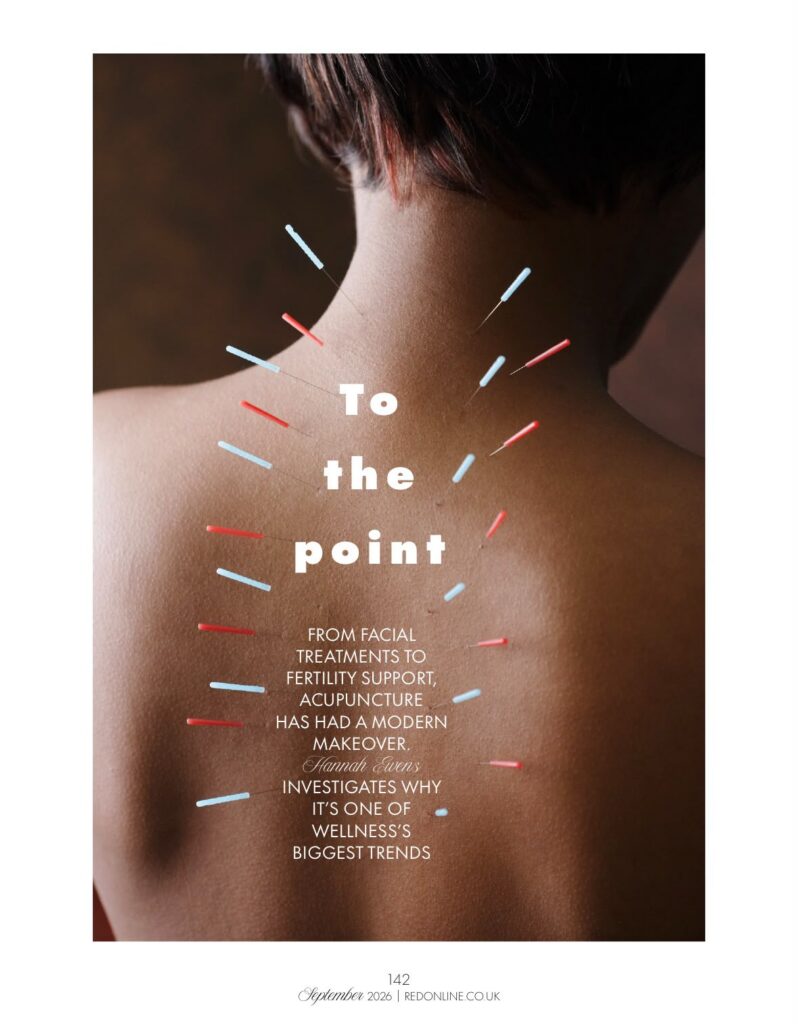
To the point
From facial treatments to fertility support, acupuncture has had a modern makeover. Hannah Ewens investigates why it’s one of wellness’s biggest trends.
Acupuncture is having a wellness moment. The ancient Chinese practice, which originated more than 2,000 years ago, is moving into the mainstream as people seek drug-free ways to manage pain, anxiety and menopause symptoms, or simply to maximise wellbeing. In 2024, the global market was worth around £42bn, but it’s projected to nearly double to £80bn by 2035.
It’s being brought up to date, too, as acupuncturists put their own twist on the procedure. Practitioners (and superfacialists) Mina Lee and Sarah Bradden have months-long waiting lists because they combine the visible results that needles can bring – relaxed muscles, glow and possibly increased collagen – with whole-body feelgood effects, too. Bradden can even use them to make lips look fuller. My interest in acupuncture was spiked when I was lucky enough to see Bradden. Lying on my back with an array of needles stuck in my face and ears, I looked like something out of one of the Hellraiser films, but I felt amazing, like I was floating on a cloud.
Other in-demand acupuncturists include Ross Barr, who lists Alexa Chung and Meghan Markle as fans, and Ada Ooi, who has reportedly treated Rooney Mara and Emma Mackey.
Entering the mainstream
Go back 15 years, and acupuncture – as well as its parent, Chinese medicine – was firmly in the ‘alternative’ medicine camp. When Chinese medicine doctor Katie Brindle first tried to bring gua sha tools to the UK in 2014, ‘people were often hostile to or prejudiced against Chinese medicine, thinking it was “woo-woo”’. Now, in acupuncture’s new, modern era, there’s been a boom in at-home acupressure tools such as spiky mats and ear seeds.
‘People are looking to Chinese medicine for help,’ says Brindle, ‘in particular if they’ve tried western medicine and it hasn’t worked, or they don’t want to or can’t take medication, for example HRT or sleeping pills, or they’re on a long waiting list for treatment and are looking for options in the meantime.’
Johnny Childs, one of the most in-demand acupuncturists in London, says, ‘Perhaps the biggest shift is that acupuncture is no longer something people turn to as a last resort. Many now see it as part of maintaining their wellbeing, in much the same way they might exercise regularly, invest in good nutrition or see a therapist.’ But why acupuncture in particular? ‘People want healthcare that feels personal and treats them as an individual rather than a collection of symptoms.’ Acupuncture, with its hyper-personal approach – no two sessions are the same – and long history, fits the bill.
What the science says
Despite its heritage, it’s probably not surprising to learn that the NHS and the National Institute for Health and Care Excellence (NICE) still take a cautious approach to acupuncture, due to a lack of evidence (although, as you’ll read below, this is changing). The NHS has approved it as a treatment for chronic tension-type headaches and migraines, and in some areas, it’s offered for other kinds of pain, too. Typically, the guidance still suggests it as a secondary or add-on treatment.
Historically, acupuncture has been a tricky treatment to study at all. Hannah Pearn, who runs a fertility acupuncture clinic in London called Don’t Tell Me To Relax and a podcast of the same name, has been working towards her own studies on acupuncture and fertility. She says that acupuncture research has been held back because it’s difficult to create a convincing placebo treatment – a cornerstone of modern clinical trials.
More recently, believable sham needles, shallow needling or needling the wrong points has allowed researchers to investigate how acupuncture may work on a biological level. ‘Chinese medicine explains acupuncture as improving energy flow around the body,’ says Brindle. But probably the foremost current western explanation is that it activates neural pathways involving the vagus nerve and autonomic nervous system.
This may explain why it’s used to help sleep issues and other multi-factorial conditions. For example, a 2025 review* found that acupuncture improves how people with chronic insomnia feel they’ve slept, compared with people treated with sham needles. The strongest scientific evidence is for treating conditions such as chronic and musculoskeletal pain, plus there’s emerging research on inflammation and hot flushes in menopause, too. And a 2021 study* showed that just one session of acupuncture triggered short-term reductions in blood pressure and heart rate.
Needle meets need
The gender balance of people having acupuncture has historically been skewed towards women. In a cultural environment in which women feel failed by medicine for conditions such as PMDD, endometriosis and PMOS (formerly PCOS), even today, this is no surprise. Acupuncture consultations for infertility increased fivefold over a 10-year period, according to a survey of practitioners.
When 44-year-old Shannon was diagnosed with PMOS at 27, she was interested to see if acupuncture would help. ‘Since my first period, I’ve always struggled with painful, irregular, heavy bleeding,’ she says. ‘Acupuncture helped not only resolve the pain, but it also made my cycles more regular.’
Acupuncture for women’s health, particularly for fertility issues, makes sense, Pearn says. One possible mechanism for the way acupuncture works is that it may influence the hypothalamic-pituitary-ovarian (HPO) axis, the hormonal network linking the brain and the ovaries.
‘If you’ve got polycystic ovaries or you’re doing a round of IVF and your ovaries aren’t responding, electroacupuncture can be really helpful,’ Pearn says. She often uses this treatment in particular to help with ovulation induction. This is a technique that’s currently getting a lot of hype on social media, ‘but adding a small current to needles is simply a way to replicate the acupuncturist vibrating them’, says Brindle.
Relax without effort
Of course, acupuncture isn’t the only answer for getting pregnant – or any other health issue, according to Gerad Kite, a specialist in fertility acupuncture. He describes his ideal clients as taking initiative in their health in whatever way they need. Fertility medicine, he says, ‘tends to isolate its understanding to female gynaecology and the endocrine system, rather than look at the bigger picture. Ideally, a client will be aware of their overall health, energy levels, symptoms (not necessarily fertility related), sleep, work/life balance and diet’, he says. ‘We can help people at the last minute – but forearmed is forewarned.’
Pinpointing release
That said, a lot of the new fans of acupuncture aren’t looking to treat an issue, but just to feel well. In the blood pressure study above, for example, researchers showed the effect came via reducing overactivity of the sympathetic nervous system, often the case for people with hypertension.
This nervous system deactivation is a sweet spot in what people are looking for from wellness, says Brindle. ‘Overwhelmed people want something that works. Acupuncture is still here after being used on millions of people for thousands of years.’
What struck me was how peaceful I felt when leaving Bradden’s clinic after a session. As she put in the needles, it wasn’t like a meditation or a sound bath or even a massage, where I was worrying if I’d got into the right state of mind or if my body was too tense. She – the practitioner – was the person in control.
‘Acupuncture gives you an automatic response from your nervous system,’ says Bradden when I put this to her. ‘Your body starts to relax even without you knowing it’s relaxing.’ If the new version of looking after yourself includes regularly lying back and letting someone else needle you into serenity, I’m all for it.
DIY acupuncture
You don’t have to go to an acupuncturist to get some of the benefit; acupressure techniques treat the same points but without needles. Here are three options you can do at home:
Acupressure mat
Lie down on one of these spikey mats for up to 15 minutes (any longer and the next day, you may look like you’ve been tortured!). Regular users report relaxation and less muscle tension.
Self-acupressure
Use your fingers or thumbs to apply pressure on points of your body. The P6 point is located three finger-widths below your wrist crease; try pressing it to help with nausea (remember those car sickness bands from when you were a child?) and stress. The Yintang point or third eye, directly between your brows, is linked to anxiety relief in Chinese medicine.
Ear seeds
These are a little bit fiddlier, but different points on your ear correspond to different areas of the body, and the seeds usually come with a map to show you where to put them. ‘Make sure that your ear is super clean – no oil or moisturiser or shampoo – then stick them on and press on them throughout the day,’ says Bradden. ‘You can’t overdo the number of times that you press.’
* Sources: Nature and Science of Sleep; Journal of Alternative and Complementary Medicine.