
Acupuncture for Fatigue and Low Energy
Understanding Fatigue and Low Energy
Persistent fatigue is one of the most common symptoms I see in clinic — yet it’s also one of the most misunderstood.
Many people describe feeling constantly drained, foggy, or depleted, even after rest. For some, the fatigue is physical, for others it’s emotional — or both.
Modern life pushes the body’s resources hard: stress, disrupted sleep, irregular eating, and constant stimulation gradually deplete energy reserves. Over time, this leads to a sense of running on empty, where even simple tasks feel effortful. In Chinese medicine, this reflects a weakening of the body’s vital energy, or Qi, and a loss of harmony between the systems responsible for maintaining it.
A Classical Five-Element Approach
Johnny Childs practises classical Five-Element acupuncture from Kite Clinic, Marylebone, and Liberty London.
His work is grounded in the classical tradition, with a contemporary focus on emotional health, fertility, and the regulation of the nervous system.
He supports people navigating fertility treatment, hormonal imbalance, stress, and complex or long-standing conditions, working at a deeper, constitutional level to restore balance over time.
“Recovery is not simply about wound healing. It is about restoring internal equilibrium”
— Johnny Childs
Western Approach to Treatment
In Western medicine, fatigue is often linked to factors such as anaemia, thyroid imbalance, post-viral recovery, or sleep disorders. Blood tests and scans may come back “normal,” yet the person still feels exhausted — physically and mentally.
When no clear cause is found, fatigue can be managed with lifestyle advice, supplements, or medication for associated symptoms such as low mood or poor sleep.
While these approaches can help, they rarely address why the body’s natural vitality has declined in the first place. Acupuncture offers a different route — one that rebuilds energy from within and restores the body’s ability to regulate itself.
IN THE PRESS

"London's most in-demand Acupuncturists..."
The former stuntman turned acupuncturist Johnny Childs trained at the Acupuncture Academy in Leamington Spa. He went on to apprentice under Gerad Kite, founder of Kite Clinic and one of the leading practitioners in five element acupuncture in Britain.
Five element acupuncture seeks to balance five core elements — wood, fire, earth, metal and water. Each element is linked to a different organ, emotion and season. Childs’s expertise covers everything from back and neck pain to IVF and pregnancy, sleep problems and insomnia, and even chemotherapy support.
His sessions are highly personalised. He seems able to detect even the smallest shifts in energy, mood and language, all of which help him to identify the best approach for an individual. Every needle placement is considered and the consultation is deeply personal. He practises out of Liberty London and the Kite Clinic on Wimpole Street, which feels closer to a private member’s club than a medical practice.
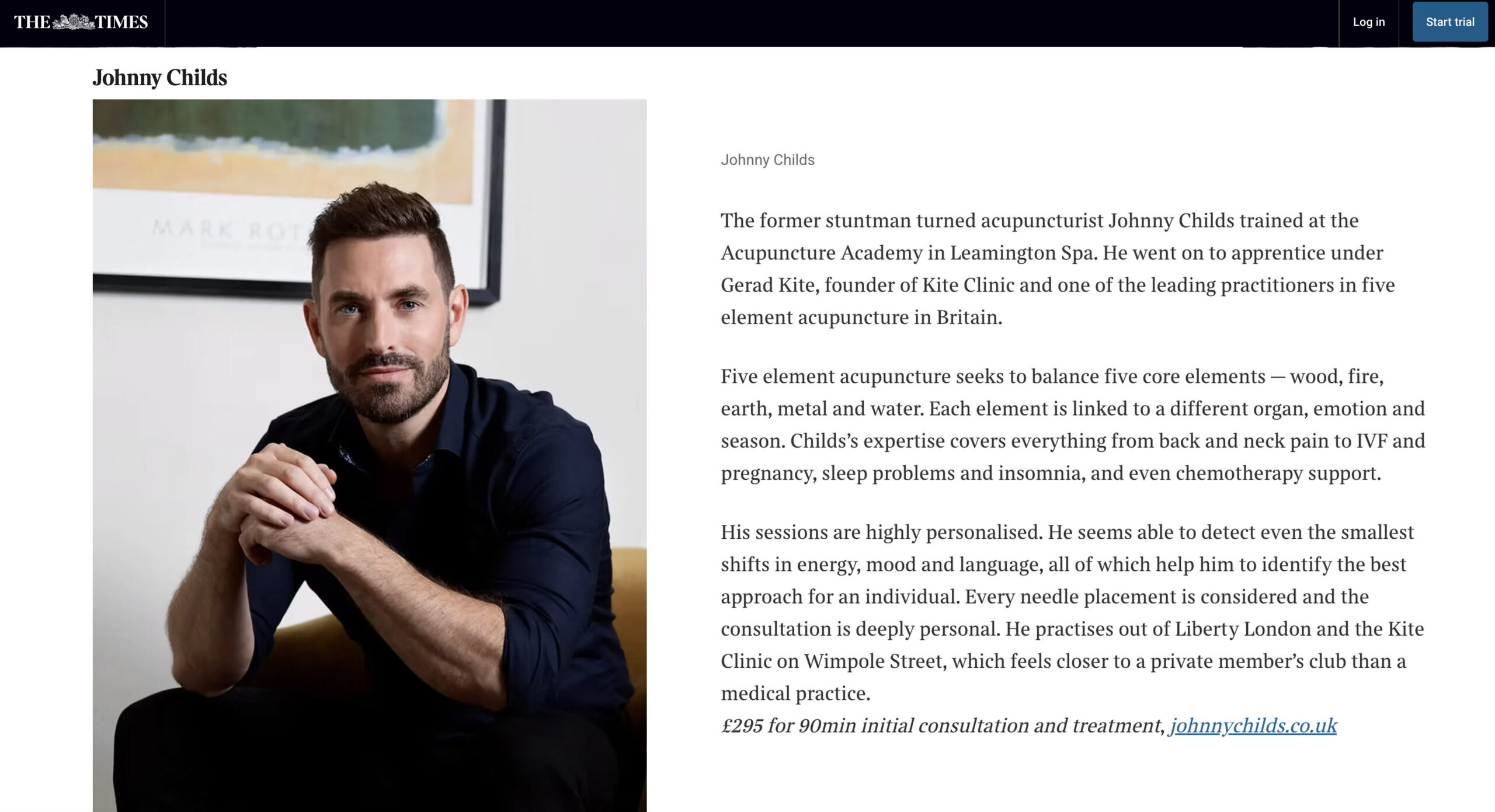
"...able to detect even the smallest shifts in energy, mood and language..."
The Five Element Acupuncture Lens
In Five Element acupuncture, fatigue is viewed not simply as a lack of energy, but as a sign that the body’s natural balance has been disrupted. The question becomes why your energy is low — where the imbalance lies and what’s preventing proper replenishment.
Each type of fatigue tells its own story.
-
A heavy, sluggish tiredness points to an imbalance in the Earth element, where digestion and nourishment are compromised.
-
A wired but tired exhaustion reflects Fire or Water imbalance, often caused by stress, overwork, or long-term anxiety.
-
Emotional fatigue may suggest a Metal imbalance, linked to grief, loss, or a lack of inspiration. By identifying and treating the underlying elemental pattern, acupuncture helps restore the body’s rhythm and renews a sense of vitality.
How Acupuncture Can Help With Fatigue and Low Energy
Acupuncture works by supporting the body’s key regulatory systems — hormonal, nervous, and digestive — to restore natural energy production. Treatment improves circulation, oxygen delivery, and cellular metabolism, helping you feel more awake and grounded.
On a deeper level, acupuncture calms the nervous system, allowing the body to shift out of “fight or flight” mode and into repair and recovery. As the body relaxes, sleep quality improves, digestion becomes steadier, and energy levels begin to rebuild naturally.
Many patients describe feeling a subtle yet profound shift — a sense of “being reconnected” to themselves. Over a course of treatments, fatigue is replaced by clarity, steadiness, and a return of motivation and joy.
Acupuncture for Fatigue and Low Energy FAQs
Appointments & Enquires
If you are considering acupuncture as part of your fertility journey, you are welcome to get in touch to discuss whether this approach feels appropriate for you. Appointments are available at Kite Clinic and Liberty London.



DISCOVER HOW ACUPUNCTURE COULD SUPPORT YOU
The areas below offer a guide to how treatment is approached across a range of common concerns.
Important note:
Acupuncture is offered here as a holistic and complementary therapy, drawing on Five-Element principles and informed by traditional Chinese medicine. Many people find it supportive, although responses vary and outcomes cannot be guaranteed. Claims about potential benefits depend on the condition and the quality of available research.
Evidence from observational studies and systematic reviews — including guidance from organisations such as the World Health Organization (WHO) and, where relevant, the National Institute for Health and Care Excellence (NICE) — suggests that acupuncture may support wellbeing and help with certain symptoms. However, it should not be considered a replacement for medical diagnosis or treatment.
Each treatment is tailored to the individual, and experiences differ from person to person. If you have a medical condition or are under the care of a GP or specialist, please continue with your prescribed treatment plan. Acupuncture can be used alongside medical care, and it is advisable to discuss any changes with your healthcare provider.